For homes with high vaulted ceilings, large ceiling fans are essential for effective air circulation and maintaining comfort. Standard fans often fall short in these expansive spaces, leading to stagnant air and uneven temperatures. The right large ceiling fan, typically with a blade span of 60 to 96 inches and a high Cubic Feet per Minute (CFM) rating of 6,000 to 15,000+, transforms these impressive rooms into energy-efficient and comfortable living areas by breaking up thermal layering and redistributing air. This guide covers essential considerations, popular types, and top models for high-ceilinged homes.
What Are Ceiling Fans? An Overview
A ceiling fan is an electromechanical device, typically suspended from the ceiling of a room, that uses rotating blades to circulate air. Its primary purpose is to create a cooling effect through air movement in warmer conditions and to redistribute warm air from the ceiling downwards in cooler months, enhancing overall comfort.
The journey of the ceiling fan began in the late 19th century as a belt-driven system. Over the decades, it has evolved significantly, incorporating electric motors, lighter materials, and increasingly sophisticated designs. Modern ceiling fans often integrate LED lighting, smart controls accessible via apps or voice commands, and energy-efficient DC motors, moving far beyond their simple utilitarian origins to become integral elements of home decor and climate control systems. Today, they are available in various mounting styles, including flush-mount for low ceilings, standard downrod mounts, and specialized sloped mounts for angled or vaulted ceilings, catering to diverse architectural needs.
Advantages and Disadvantages of Ceiling Fans
Ceiling fans offer a compelling mix of benefits, particularly in large spaces with high ceilings, but they also come with certain limitations that warrant consideration. Understanding both sides helps in making an informed decision for your home.
Advantages:
- Energy Efficiency: Compared to air conditioning units, ceiling fans consume significantly less electricity. They create a wind-chill effect, making a room feel cooler without actually lowering the temperature, allowing homeowners to set thermostats higher and reduce cooling costs. In winter, reversing the blade direction gently pushes warm air, which naturally rises, back down into the living space, further optimizing heating efficiency.
- Enhanced Air Circulation: In rooms with high or vaulted ceilings, hot air tends to stratify at the top, leaving the lower living areas feeling stuffy. Large ceiling fans are adept at breaking up this thermal layering, ensuring a more consistent and comfortable temperature throughout the entire room. This constant movement prevents stale air and can even help dissipate odors.
- Aesthetic Appeal: Beyond their functional role, modern ceiling fans are designed to be statement pieces. With an immense variety of styles, finishes, and blade designs, from rustic farmhouse to sleek contemporary, they serve as powerful decorative elements that can complement or define a room’s interior design, adding elegance and character to the ceiling.
- Lower Installation and Maintenance Costs: Generally, the initial purchase and installation of a ceiling fan are less expensive than a full air conditioning system. Their maintenance primarily involves periodic cleaning of the blades and motor housing, making them a cost-effective long-term solution for climate control.
Disadvantages:
|
Our Picks for the Best Ceiling Fan in 2026
As an Amazon Associate I earn from qualifying purchases.
|
||
| Num | Product | Action |
|---|---|---|
| 1 | Passky Ceiling Fans with Lights, 52 inch Flush Mount Ceiling fan with Remote Control, Low Profile Ceiling Fan for Bedroom, Farmhouse, Reversible, 3CCT, Dimmable, Noiseless DC Motor, Black |

|
| 2 | OJX Ceiling Fans with Lights, 52 inch Ceiling fan with Light and Remote/APP Control, 3CCT, Quiet DC Reversible, Dimmable, Modern Ceiling Fan for Bedroom, Living Room, Kitchen, Indoor/Outdoor Use |
|
| 3 | 41" Black Low Profile Ceiling Fans with Lights and Remote, Modern Flush Mount Ceiling Fan Light with Quiet Reversible DC Motor for Bedroom Kitchen |
|
| 4 | ZMISHIBO 52 Inch Ceiling Fan with Light, App&Remote Control, Flush Mount Low Profile, Dimmable 20W LED Light, Quiet Reversible Motor for Bedroom, Living Room, Apartment, Black |
|
| 5 | 41 inch Ceiling Fans with Lights, Black Flush Mount Ceiling Fan with Remote, 3CCT, LED Dimmable, Reversible, 6 Fan Speeds, Quite Low Profile Ceiling Fan with Lights Modern Bedroom Kitchen Indoor |
|
| 6 | Ceiling Fans with Lights, 42 Inch Ceiling Fan with Light And Remote, 3CCT Flush Moun Low Profile Ceiling Fans, 6 Speed Noiseless LED Ceiling Fan, Black Ceilings Fan with Remote for Bedroom Living Room |
|
| 7 | Ceiling Fan with Light, 40" Black Flush Mount Ceiling Fans with Remote Control,3CCT Dimmable LED, ABS 5-Fan Blades,Reversible Motor,Quiet Low Profile Indoor fandeliers for Bedroom Living Room |
|
| 8 | ZMISHIBO Ceiling Fans with Lights and Remote, 19.7'' Low Profile Ceiling Fan, 3000-6000K Dimmable Modern Flush Mount LED Fan Light, 6 Wind Speeds, Black Fandelier Ceiling Fans for Bedroom |
|
| 9 | Amico Ceiling Fans with Lights, 42 inch Low Profile Ceiling fan with Light and Remote Control, Flush Mount, Reversible, 3CCT, Dimmable, Noiseless, Black Ceiling Fan for Bedroom, Indoor/Outdoor Use |
|
| 10 | Passky Ceiling Fans with Lights, 52 inch Sleek Ceiling Fan with Light and Remote Control, 3CCT, Dimmable, Reversible, Noiseless, Black Ceiling Fan for Bedroom, Living Room |
|
- Limited Cooling Capacity in Extreme Heat: While effective at creating a cooling sensation, ceiling fans do not actually reduce the ambient temperature of a room. In extremely hot and humid climates, they may not provide sufficient comfort on their own and typically need to be used in conjunction with air conditioning.
- Potential for Noise: Although many modern fans are designed for quiet operation, some models, especially older or less expensive ones, can produce noticeable motor hum or blade wobble, particularly at higher speeds. This can be a concern in quiet living spaces or bedrooms.
- Requires Regular Cleaning: Fan blades inevitably collect dust and grime, which can be distributed into the air if not cleaned regularly. For fans installed on very high vaulted ceilings, accessing the blades for cleaning can be challenging and may require specialized equipment or professional help.
- Ceiling Space Occupation: Large ceiling fans, by their very nature, occupy a significant overhead presence. While this can be a decorative advantage, it might feel visually intrusive in rooms where homeowners prefer an uncluttered ceiling, or where very low hanging light fixtures are also desired. Ensuring proper clearance from the floor and walls is crucial for both safety and optimal performance.
Popular Types of Ceiling Fans for Vaulted Ceilings
When selecting a ceiling fan for a high vaulted ceiling, several design and material considerations come into play, influencing both performance and aesthetic integration. Each type offers distinct characteristics that can better suit specific room styles and functional needs.
Wooden Blade Ceiling Fans
Wooden blade ceiling fans exude a classic, warm aesthetic, often favored in traditional, rustic, or farmhouse-style interiors. The blades can be crafted from various wood types, offering a range of grains and finishes, from dark mahogany to light oak. While visually appealing, solid wood blades can be heavier, which might impact the fan’s maximum speed and air movement (CFM) slightly compared to lighter materials. However, modern designs often incorporate lightweight wood composites or carved wood, optimizing performance while retaining the natural look. These fans are excellent for creating a cozy, inviting atmosphere.
Metal Blade Ceiling Fans
Metal blade ceiling fans typically project a more industrial, modern, or contemporary vibe. Materials like aluminum, steel, or brushed nickel are common, offering sleek lines and often a more robust appearance. Metal blades are generally thinner and can be designed with a steeper pitch, allowing them to move a significant volume of air efficiently. This makes them highly effective for cooling large spaces. They are also known for their durability and can be a good choice for high-traffic areas or commercial settings integrated into residential designs. Some industrial-style fans specifically designed for large, high-ceiling spaces feature extruded aluminum blades, optimizing airflow and energy efficiency.
Ceiling Fans with Lights
Ceiling fans with integrated lighting are a highly functional choice, combining two essential room elements into one fixture. This is particularly advantageous for high vaulted ceilings, where a single central fixture can serve both as a primary light source and an air circulator. The lighting can range from traditional incandescent to modern LED arrays, often with dimming capabilities and adjustable color temperatures. This type eliminates the need for separate lighting fixtures, simplifying installation and wiring while maintaining a cohesive look. Many models allow the light kit to be optional or covered if not desired.
Bladeless/Unique Design Ceiling Fans
While truly “bladeless” ceiling fans are rare, some designs employ enclosed or highly compact blades within a minimalist housing, giving a sleek, contemporary appearance. More broadly, this category encompasses fans with unconventional designs, such as those with fewer, wider blades, or highly stylized forms that prioritize artistic expression alongside air movement. These fans are ideal for ultra-modern or avant-garde interiors where a strong design statement is desired. Their unique construction often focuses on quiet operation and smooth airflow, though their CFM may vary depending on the specific design.
Mini Ceiling Fans
Mini ceiling fans, typically with blade spans under 42 inches, are primarily designed for smaller rooms, bathrooms, or compact spaces. While generally not suitable as the primary air circulation solution for large, high vaulted ceilings due to their limited airflow capacity, they might be considered for specific, smaller zones or niches within a larger open-concept space where targeted air movement is needed without overpowering the overall design or airflow of a main large fan. Their application in the context of large vaulted ceilings is therefore highly specialized and not for general room cooling.
Comparative Table of Ceiling Fan Types
To assist in choosing the ideal ceiling fan for your high vaulted ceiling, here’s a comparative overview of common types, focusing on characteristics relevant to expansive spaces.
| Feature | Wooden Blade Fans | Metal Blade Fans | Fans with Lights | Bladeless/Unique Design Fans |
|---|---|---|---|---|
| Material | Solid wood, wood composite | Aluminum, steel, brushed nickel | Various (wood, metal, plastic) | Various (plastic, metal) |
| Design | Traditional, rustic, farmhouse | Industrial, modern, contemporary | Versatile, integrates lighting | Ultra-modern, minimalist |
| Power (CFM) | Moderate to High (weight-dependent) | High (efficient air movement) | Moderate to High | Moderate |
| Noise | Generally quiet | Can be louder at high speeds (some) | Generally quiet | Very quiet (enclosed designs) |
| Price | Mid to High | Mid to High | Mid to High | High |
| Advantages | Warm aesthetic, classic look | Durable, high airflow, sleek | Dual function, space-saving | Aesthetic statement, quiet |
| Disadvantages | Heavier, less max CFM (some) | Can appear stark, potential for noise | Light integration limits design | Often lower CFM, higher cost |
How to Choose the Right Ceiling Fan for High Vaulted Ceilings
Selecting the optimal ceiling fan for a room with high vaulted ceilings requires careful consideration of several factors beyond just aesthetics. The right choice ensures comfort, efficiency, and safety.
Assess Your Needs
Begin by accurately measuring your room’s dimensions—length, width, and importantly, the maximum height of your vaulted ceiling. For rooms exceeding 325-400 square feet, large fans with blade spans from 60 to 90 inches are typically recommended. Consider the primary purpose: is it for general cooling, supplemental heating, or mainly decorative? The functional demands will guide your choice of features like CFM rating and motor type. Also, reflect on how often the fan will be used and if energy efficiency is a top priority.
Match Fan Type to Room Style and Ceiling
The fan should visually complement your interior design. For grand, traditional spaces, a multi-blade wooden or ornate metal fan might be suitable. Modern or industrial vaulted spaces may benefit from sleek, large-diameter metal-bladed fans or unique, minimalist designs. Crucially, verify that the fan is “sloped ceiling compatible.” Most quality fans accommodate angles up to 27-30 degrees with a standard pivoting canopy, but steeper pitches (up to 45-60 degrees) will require a specialized slope adapter kit, often purchased separately. Ensure you select a fan that can be mounted with an extended downrod to position the blades ideally 8 to 9 feet from the floor for optimal airflow.
Consider Power (CFM) and Noise Level
For high vaulted ceilings and large rooms, a high Cubic Feet per Minute (CFM) rating is essential for effective air circulation. Look for fans with a CFM of 6,000-8,000 or even higher, especially for ceilings exceeding 12 feet, where you might need 20-30% more CFM than standard recommendations. Pay attention to the motor type; DC (Direct Current) motors are generally more energy-efficient, quieter, and offer more speed options compared to traditional AC motors. A blade pitch between 12-15 degrees is also ideal for balancing robust airflow with energy efficiency.
Check Quality and Safety Standards
Prioritize fans from reputable brands known for their durability and performance. Verify that the fan is UL-listed or meets other relevant safety standards. For installation on vaulted ceilings, the electrical junction box must be “fan-rated” and securely mounted to a structural joist, capable of supporting at least four times the fan’s weight (minimum 35 kg). This ensures the fan remains stable and safe, preventing wobbling or detachment. Always confirm adequate clearance: blades should be at least 7 feet (2.1 meters) from the floor and 18 inches from the nearest wall or obstruction.
Consult Reviews and Experts
Before making a final decision, read user reviews for insights into real-world performance, noise levels, and ease of installation. User experiences can highlight potential issues or exceptional qualities not always apparent in product specifications. For complex installations or very specific requirements of high vaulted ceilings, consulting a licensed electrician or a ceiling fan specialist can provide invaluable advice and ensure proper, safe setup.
Top Large Ceiling Fans for High Vaulted Ceilings
For expansive rooms with dramatic vaulted ceilings, selecting a fan that combines power, reach, and sophisticated design is paramount. Here are some of the best large ceiling fans making waves in 2026, known for their performance in challenging spaces.
Honeywell Kensgrove 72-inch Ceiling Fan
The Honeywell Kensgrove is a formidable choice for truly expansive areas. Its impressive 72-inch blade span ensures powerful air movement, making it suitable for rooms over 400 square feet. This fan often comes with an integrated light kit, providing both illumination and comfort. Its versatile design seamlessly fits classic, contemporary, and modern aesthetics. With remote control operation and wet-rating for outdoor use, the Kensgrove offers flexibility, though it relies solely on the remote for control.
- Brand: Honeywell
- Model: Kensgrove
- Blade Span: 72 inches
- CFM: High (specific values vary by model iteration)
- Features: Integrated LED light kit, reversible motor, remote control, wet-rated for outdoor/indoor use.
- Pros: Excellent for very large spaces, versatile design, durable, good airflow.
- Cons: No pull chain, remote-only control might not suit all preferences.
TroposAir Titan II 84-inch Ceiling Fan
The TroposAir Titan II is an industrial-style powerhouse, perfect for grand rooms and open-concept layouts with high ceilings. Its 84-inch span is designed for maximum air displacement, pushing a substantial 15,144 cubic feet per minute (CFM) of air. This fan features a high-performance DC motor, offering superior energy efficiency and multiple speed settings. It’s available in various finishes like oil-rubbed bronze and brushed nickel, and often includes an optional light kit. The Titan II is frequently lauded for its robust construction and ability to make a significant impact on comfort in large volumes of air.
- Brand: TroposAir
- Model: Titan II
- Blade Span: 84 inches (also available in 66″ and 72″)
- CFM: Up to 15,144 CFM (for 84″ model)
- Features: Energy-efficient DC motor, 6 speeds, remote control, optional LED light kit, available in various finishes.
- Pros: Exceptionally high airflow, quiet DC motor, industrial chic design, suitable for indoor/outdoor.
- Cons: Large size may overwhelm smaller “large” rooms, premium price point.
Minka Aire Xtreme 96-inch Ceiling Fan
For the ultimate in grand scale and efficiency, the Minka Aire Xtreme stands out with an imposing 96-inch blade span. This fan is engineered with one of the most energy-efficient DC motors available, achieving an impressive EPA Airflow Efficiency Rating of 537 while consuming minimal wattage on its highest speed. The Xtreme features nine distinctive blades, providing widespread air circulation ideal for vast open areas and soaring ceilings. Its sleek design, often in finishes like brushed nickel or oil-rubbed bronze, complements contemporary and modern industrial decors.
- Brand: Minka Aire
- Model: Xtreme (e.g., F896-65-BNW)
- Blade Span: 96 inches
- CFM: Very High (optimized for efficiency)
- Features: Ultra-energy-efficient DC motor, 9 blades, remote control, often wet-rated.
- Pros: Massive air movement for colossal spaces, unparalleled energy efficiency, sleek modern aesthetic.
- Cons: Very large size requires careful planning, higher initial investment.
Craftmade Colossus 96-inch Ceiling Fan
The Craftmade Colossus lives up to its name, offering robust air circulation for the largest residential or commercial-style spaces. Similar to the TroposAir Titan, it utilizes six extruded aluminum blades powered by an efficient DC motor, capable of moving substantial air volumes quietly. The Colossus typically comes with a six-speed handheld remote control, and often includes an in-wall control as a bonus, providing versatile operation options. Its industrial-modern design makes a bold statement in any large, high-ceiling environment.
- Brand: Craftmade
- Model: Colossus
- Blade Span: 96 inches
- CFM: High (designed for large volume air movement)
- Features: Powerful DC motor, 6 extruded aluminum blades, 6 speeds, handheld remote & in-wall control.
- Pros: Excellent airflow, dual control options, durable construction, striking design.
- Cons: Requires significant ceiling space, installation can be complex due to size.
Hunter Bureau 60-inch Ceiling Fan
For high vaulted ceilings in rooms up to 400 square feet, the Hunter Bureau 60-inch ceiling fan offers a stylish and effective solution. Its modern design makes it suitable for contemporary or even modern Bohemian spaces, providing ample lighting and airflow. Hunter fans are known for their reliability and often feature their SureSpeed™ Guarantee, ensuring optimized high-speed airflow. This model typically includes versatile mounting options compatible with standard, angled, and low ceilings, making it adaptable for various vaulted designs with the correct downrod.
- Brand: Hunter
- Model: Bureau
- Blade Span: 60 inches
- CFM: High (optimized by SureSpeed™ technology)
- Features: Modern aesthetic, SureSpeed™ Guarantee, versatile mounting (with appropriate downrod), often with integrated light.
- Pros: Reliable brand, modern design, good airflow for large rooms, adaptable mounting.
- Cons: May not be sufficient for extremely large rooms (over 600 sq ft) compared to larger models.
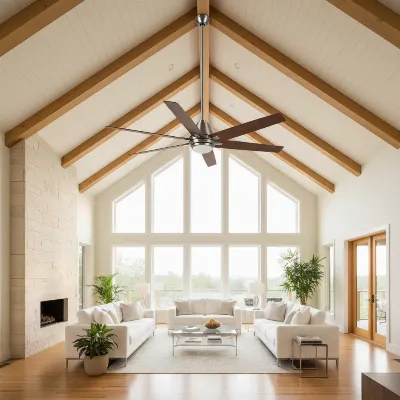 A modern large ceiling fan with sleek, long blades installed on a high vaulted ceiling in a spacious living room with natural light.
Installation and Maintenance Guide for Ceiling Fans on Vaulted Ceilings
Proper installation and regular maintenance are crucial for the safe and efficient operation of large ceiling fans, especially when mounted on high vaulted ceilings. Due to the unique challenges presented by angled and elevated surfaces, careful attention to detail is paramount.
Safe Installation Steps
- Safety First: Power Isolation. Before touching any wiring, always switch off the power to the circuit at your home’s main electrical panel. Use a voltage tester to confirm the power is off at the installation site.
- Structural Support. For a large, heavy ceiling fan, the existing electrical box must be “fan-rated” and securely anchored to a structural joist or rafter. This box needs to be capable of supporting at least 35 kg, or four times the fan’s weight. Vaulted ceilings may require additional bracing or reinforced beams to provide adequate support.
- Mounting Bracket & Slope Adapter. Attach the fan’s mounting bracket to the electrical box. For vaulted ceilings, a slope adapter or an angled mounting kit is essential to ensure the fan’s downrod hangs perfectly vertical, preventing wobble and maintaining balance. Most fans include a pivoting canopy for moderate angles (up to 27-30 degrees), but steeper pitches (up to 45-60 degrees) will require a dedicated adapter that allows angles up to 45 or even 60 degrees. Level the bracket carefully before proceeding.
- Downrod Selection and Assembly. For high ceilings, a longer downrod is critical. It positions the fan blades at an optimal height—ideally 8 to 9 feet from the floor (minimum 7 feet for safety)—to effectively circulate air in the living space, rather than just near the ceiling. Measure your ceiling height and subtract the fan’s body height to calculate the appropriate downrod length. Always use downrods from the same manufacturer as your fan to ensure compatibility and a matching finish.
- Wiring and Hanging. Thread the electrical wires through the downrod and then through the fan’s hanger ball. With assistance, carefully lift the fan motor assembly, seat the hanger ball into the mounting bracket, and secure it. This allows the fan to hang while you make the electrical connections (ground, neutral, hot wires). Ensure all connections are tight and secure.
- Blade Installation and Balancing. Attach the fan blades according to the manufacturer’s instructions, often in a diagonal pattern to maintain initial balance. After assembly, turn on the fan. If you notice any wobbling, use a blade balancing kit (often included with the fan) to identify and correct the imbalance. Persistent wobble is usually a sign of mounting issues or uneven blade installation rather than a motor problem.
Cleaning and Maintenance Tips
- Regular Dusting: Dust collects quickly on fan blades. Use a soft cloth, duster, or a vacuum cleaner with a brush attachment to regularly wipe down the blades, especially the top surfaces, to prevent dust from accumulating and being redistributed into the air. For high ceilings, an extendable duster or a safe, stable ladder is necessary.
- Tighten Fasteners: Periodically check all screws and fasteners on the fan body, blade attachments, and mounting bracket. Vibrations from normal operation can sometimes loosen them, leading to wobble or noise.
- Seasonal Direction Reversal: Optimize your fan’s efficiency by reversing its motor direction seasonally. In summer, set the fan to rotate counter-clockwise to create a downdraft, producing a cooling breeze. In winter, switch it to rotate clockwise (at a lower speed) to gently pull cool air up and push warm air, which collects at the ceiling, back down into the room, aiding in heat distribution.
- Professional Inspection: For fans on very high or inaccessible vaulted ceilings, consider a professional inspection every few years to ensure all components are secure and the wiring is in good condition, especially if you notice unusual noises or performance issues.
Common Issues and Troubleshooting
- Wobbling: The most common issue. First, check that the mounting bracket is securely attached to a fan-rated electrical box and structural support. Ensure the downrod is fully seated in the hanger ball. Then, check that all blade screws are tight and that the blades are evenly installed. If wobble persists, use a balancing kit.
- Noisy Operation: A humming noise often indicates an issue with the motor or wiring. Ensure all electrical connections are secure. If it’s a clicking sound, check for loose screws on blade attachments or light kits. A grinding noise might suggest a worn-out motor bearing, which may require professional service.
- Fan Not Turning On: Check the circuit breaker. Ensure all wiring connections are correct and secure, especially for the remote control receiver if applicable. Test the remote’s batteries and try re-pairing it with the fan if it has a smart control system.
- Ineffective Airflow: Verify the fan is rotating in the correct direction for the season. Ensure the blades are at the optimal height (8-9 feet from the floor). If the room is exceptionally large, consider if the fan’s CFM rating is adequate or if multiple fans might be needed.
Where to Buy Reliable Large Ceiling Fans for High Vaulted Ceilings
When investing in a large ceiling fan for a high vaulted space, sourcing from reliable retailers ensures you receive a quality product with proper support. There are several avenues to explore, each offering different advantages.
Specialty Fan Stores and Lighting Showrooms: These establishments often have knowledgeable staff who can provide expert advice tailored to your specific ceiling height and room dimensions. They typically offer a wider selection of high-end brands and models specifically designed for large, high, or sloped ceilings, including those requiring extra-long downrods or specialized mounting kits. Their expertise is invaluable for navigating complex installations and finding unique design solutions.
Major Home Improvement Retailers: Large chains like Home Depot, Lowe’s, or local equivalents, carry a broad range of ceiling fans from various brands. While their selection for extra-large or high-vaulted specific fans might be more limited than specialty stores, they often stock reputable brands like Hunter and Honeywell. These stores are convenient for in-person viewing and often have competitive pricing. Ensure you check product specifications carefully for compatibility with sloped ceilings and appropriate downrod lengths.
Online Retailers and Marketplaces: Websites such as Amazon, Wayfair, ModernFanOutlet.com, and BeesLighting.com offer an extensive selection, often including highly specialized or industrial-grade large ceiling fans from brands like TroposAir, Minka Aire, and Craftmade. Online platforms provide detailed product descriptions, customer reviews, and filters for specific features like blade span, CFM, and sloped-ceiling compatibility. However, ensure the retailer has a clear return policy and reliable customer service, especially for larger, more expensive items. Always prioritize authorized dealers to guarantee warranty coverage and genuine products.
Direct from Manufacturer Websites: Many premium ceiling fan brands sell directly from their own websites. This can be a good option for ensuring authenticity and accessing their full catalog, including any proprietary accessories or extended warranty options. This also guarantees you receive the latest models and direct manufacturer support.
Regardless of where you purchase your fan, always verify the retailer’s return policy, warranty information, and whether they offer installation services or recommendations for certified installers, especially for the challenging setup of a large fan on a high vaulted ceiling.
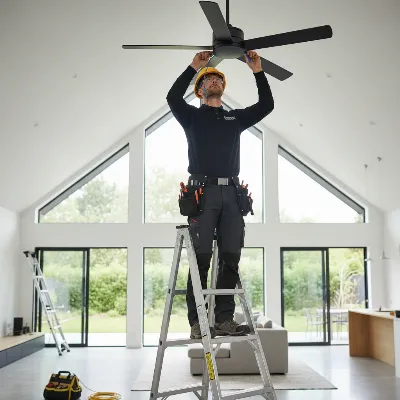 An electrician installing a large ceiling fan on a high vaulted ceiling, demonstrating the careful process.
Frequently Asked Questions
Why are long downrods necessary for high ceilings?
Long downrods are crucial for high and vaulted ceilings because they position the fan blades at an optimal height—typically 8 to 9 feet (2.4-2.7 meters) from the floor. This ensures that the fan can effectively circulate air within the living space, rather than merely pushing air near the ceiling where it has less impact on comfort. Without a sufficiently long downrod, the fan would be too high to create a noticeable breeze, diminishing its effectiveness.
Can I install a ceiling fan on a very steep vaulted ceiling?
Yes, it is possible to install a ceiling fan on a very steep vaulted ceiling, but it requires specific hardware. While many fans come with a pivoting canopy that accommodates moderate angles (up to about 27-30 degrees), steeper pitches (up to 45-60 degrees) will necessitate a specialized slope adapter kit. This adapter ensures the fan’s downrod hangs straight down, allowing the blades to rotate level and safely. Always check the fan’s specifications and consult with an expert or licensed electrician for very steep installations.
What CFM should I look for in a large room with high ceilings?
For large rooms with high vaulted ceilings, you should look for a ceiling fan with a high Cubic Feet per Minute (CFM) rating. A good starting point is 6,000 to 8,000 CFM or higher. For ceilings exceeding 12 feet, consider increasing this by 20-30% compared to standard recommendations to ensure effective air circulation throughout the expansive volume

I was looking for a fan with a high CFM rating for our great room, and the guide helped me narrow it down. We went with one that has a 12,000+ CFM, and it really moves the air around. My only minor complaint is that the remote control feels a little cheap for such a premium fan, but it functions fine. Overall, very happy with how it breaks up the thermal layering.
I appreciate the info on blade spans; it helped me understand why our old fan wasn’t cutting it. We got a 60-inch fan, and while it’s better than before, I still feel like the air circulation could be stronger in the far corners of our very large, open-concept space. Maybe I should have gone for one of the 80-inch options. Installation was a bit of a pain too, but that’s probably on me.
This guide was spot on about standard fans falling short in expansive spaces. Our old fan just pushed air around directly underneath it. After reading this, I focused on fans designed for high vaulted ceilings, specifically looking for those with a larger blade span and higher CFM. The difference is night and day; our home finally feels consistently comfortable without cranking the AC.
We just installed the ‘Big Air Mover’ model you mentioned for our living room with a 20-foot vaulted ceiling, and it’s made a huge difference. Before, the heat would just sit up top, but now the air feels so much more even. The 72-inch blade span really does the trick, and it’s surprisingly quiet for its size. Definitely worth the investment for comfort.